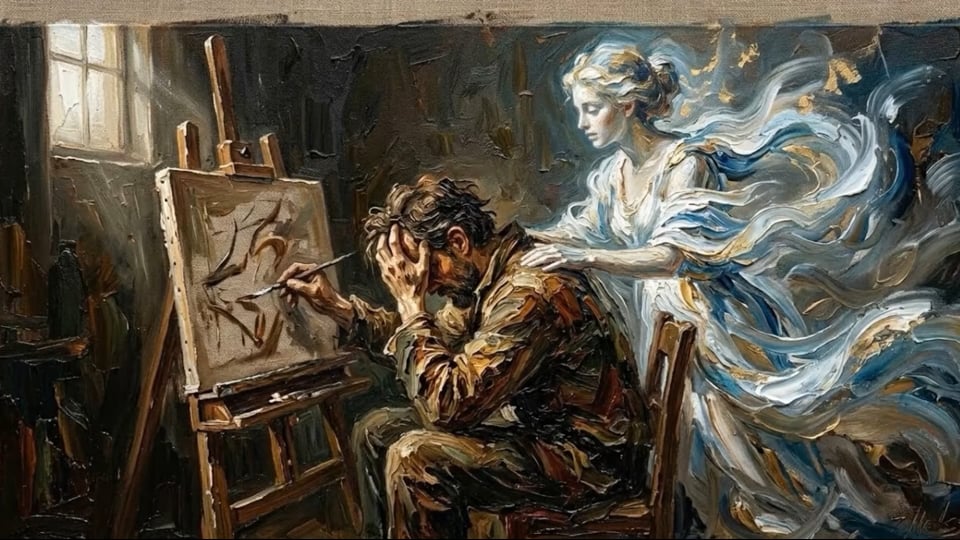
At the core of Jean Boutin artistic practice lies an abiding fascination with surface with how materials sit atop one another, how light catches grooves and impasto edges, how viewers perceive three-dimensionality even when gazing at two-dimensional surfaces. This concern with texture and structure distinguishes his work from purely conceptual or illustrative approaches.
The Physical Reality of Surface
Before exploring Boutin’s digital practice, understanding his background in physical materials proves essential. He spent formative years developing intuitive mastery of how pigment behaves on canvas, how palette-knife application creates visible evidence of artistic gesture, how textured surfaces transform color perception.
This wasn’t merely technical training; it represented foundational education in how human perception processes visual information. Textured surfaces create visual interest partially through their physical properties the way light bounces differently off flat areas versus grooved surfaces, how shadow pools in indentations. Understanding these optical effects came through direct experience with physical media.
This knowledge provides bedrock for Boutin’s digital practice. When he engineers texture into digital compositions, he does so from experiential understanding of how texture functions perceptually, not from abstract theory. His digital textures maintain associative connection to physical paint application even while behaving according to digital physics.
Structure as Compositional Foundation
Beyond surface texture, structure refers to the underlying organization that gives artworks coherence. Boutin’s compositions employ sophisticated structural principles that organize visual information meaningfully.
Some of his pieces employ grid-like structures that recall modernist painting’s geometric foundations. Others utilize organic structures inspired by natural forms branching patterns, flowing curves, clustered formations. Still others develop structures based on mathematical principles, creating patterns that feel both intentional and somehow inevitable.
These structural approaches serve multiple functions. They organize visual information so viewers can navigate complex compositions. They create rhythm and pacing that guide attention. They carry semantic meaning, suggesting order, chaos, growth, or dissolution depending on structural approach employed.
Impasto as Expressive Language
Impasto paint applied thickly enough to create visible ridges and texture represents one of painting’s most direct forms of gestural expression. The physical effort required to apply paint this heavily, the visible evidence of artist’s hand in resulting texture, the shadows cast by raised paint surfaces all contribute to impasto’s communicative power.
Boutin carries this tradition into digital space. His pieces feature what might be called “digital impasto” textured surfaces that visually recall thickly applied paint while behaving according to digital animation principles. These surfaces catch light dynamically, creating shadows that move as the pieces animate. The resulting effect captures expressive power of physical impasto while introducing temporal dimension that static paintings cannot achieve.
Negative Space and Compositional Breathing Room
Sophisticated understanding of structure encompasses not just what’s included in compositions but what’s omitted. Negative space areas of relative visual simplicity or emptiness allows complex elements room to function.
Boutin employs negative space strategically. Some pieces feature areas of relative calm that contrast with intensely textured regions. These quieter areas serve compositional function comparable to white space in graphic design or silence in music they make surrounding complexity more perceptible through contrast.
This reflects mature understanding of composition that many artists take years developing. Rather than maximizing every area with visual information, Boutin recognizes that compositional power often relies on strategic restraint.
Layering and Depth Perception
Working digitally doesn’t mean abandoning concerns with spatial depth that preoccupied painters throughout history. Instead, Boutin approaches layering as compositional strategy using overlapping visual elements, varying opacity levels, and hierarchical organization to create convincing spatial illusions.
His pieces frequently feature multiple layers of texture and form. Some elements appear to exist behind others; some seem to push forward into viewer space. This layered approach creates visual complexity while maintaining spatial coherence. Viewers perceive depth even though they’re watching two-dimensional screens.
Texture as Temporal Information
One distinctive aspect of Boutin’s practice involves treating texture as element that changes temporally. As his pieces animate, textured surfaces shift, revealing different textural qualities as light moves across them. Impasto ridges create moving shadows; surface grooves catch light differently as angles shift.
This transforms texture from static formal property into dynamic element. Viewers experience textured surfaces differently across time; aspects revealed in one moment remain hidden in another. This adds visual interest comparable to how viewers perceive painted surfaces differently depending on viewing angle and lighting conditions.
Cultural and Historical Context
Boutin’s interest in texture and structure connects to broader art-historical developments. Twentieth-century painters invested tremendous effort in exploring surface qualities from the gestural abstraction of Abstract Expressionism to the mark-making emphasis of Neo-Expressionism. These movements established that artistic integrity could rest entirely on sophisticated engagement with material surface and gestural mark.
Boutin’s work continues this tradition while extending it into digital contexts. He maintains conviction that artistic sophistication needn’t involve representation, narrative, or conceptual complexity beyond formal concerns. Instead, form itself texture, structure, composition can carry full artistic weight.
Technical Mastery in Service of Vision
Achieving Boutin’s textured, structured surfaces requires substantial technical skill. He must understand both traditional painterly concerns and advanced digital animation capabilities. His surfaces don’t simply appear textured; they’re engineered to respond to light, animation, and viewer perception according to specific artistic intentions.
This technical mastery remains subordinate to artistic vision rather than driving it. Boutin uses technical capability to realize specific artistic ideas, not to showcase technical prowess for its own sake. This distinction between artists using technology because they have it versus using it because it serves necessary artistic functions separates serious artistic practice from technical demonstration.
Conclusion
The role of texture and structure in Jean Boutin’s artistic style reflects conviction that formal sophistication remains fundamentally important to contemporary art. By combining deep understanding of how textured surfaces function visually with advanced technical capability, he creates pieces that honor traditional painting’s material concerns while introducing new possibilities. His work demonstrates that concern with surface, structure, and formal relationships hasn’t become obsolete in digital contexts; instead, these concerns remain vital to creating visually sophisticated, emotionally resonant work. Through careful attention to texture and thoughtful structural organization, Boutin proves that abstract visual language can achieve remarkable depth and power.
Leave a Reply